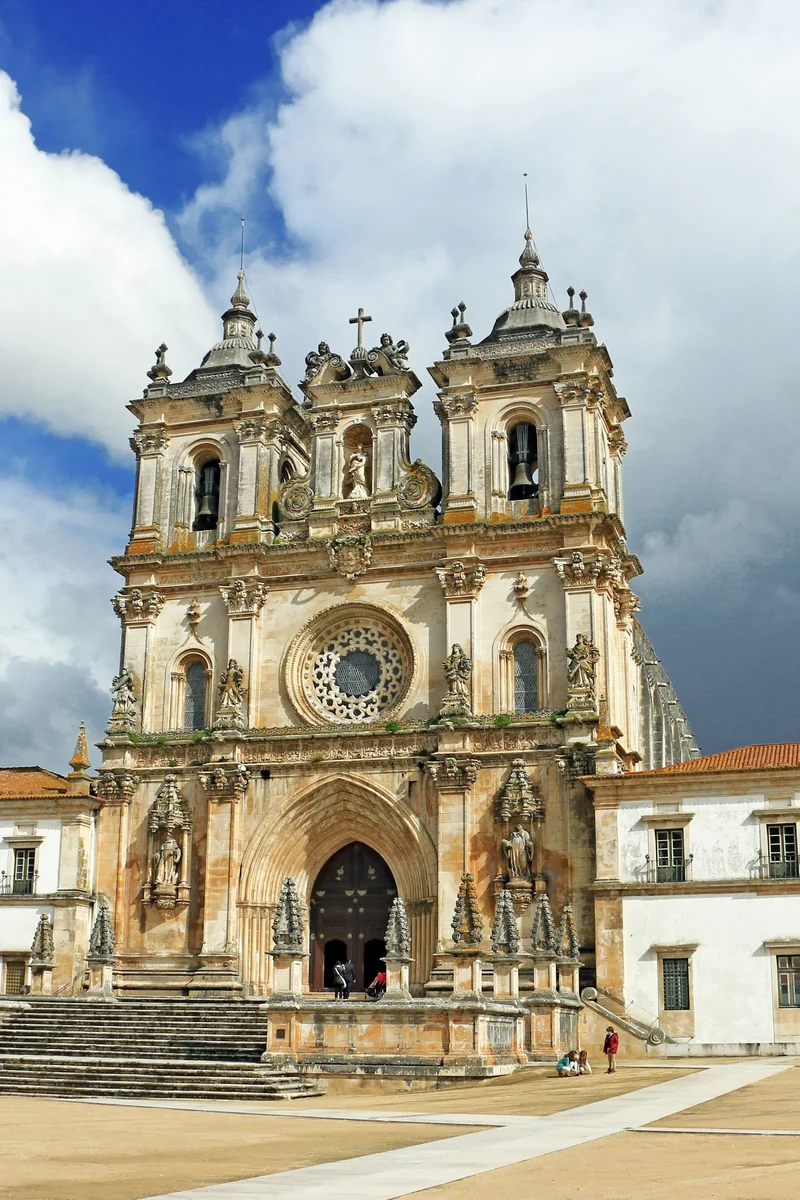
Mosteiro de Alcobaça in central Portugal — the long Cistercian limestone facade of Santa Maria de Alcobaça with its central rose window and twin bell towers. UNESCO World Heritage Site since 1989, the resting place of King Pedro I and Inês de Castro.

Where two tombs face each other

Mosteiro de Santa Maria de Alcobaça — Portugal's first and largest Cistercian abbey, founded in 1153 by King Afonso Henriques. The carved tombs of Pedro I and his murdered lover Inês de Castro lie foot-to-foot in the transept, set so that on the Day of Judgement they will see each other first.

See ticket options
  • UNESCO World Heritage Site, 1989 — Cistercian masterpiece
  • 1153 Founded by King Afonso Henriques, Portugal's first king
  • 106 metres Length of the austere Cistercian nave — Portugal's largest
  • Pedro & Inês The most famous medieval love-story tombs in Portugal

Choose your ticket

Adult (Monastery entry)

Live availability

Ages 25+ — or any age without student/senior ID

€22

  • Skip-the-line entry to Mosteiro de Santa Maria de Alcobaça
  • Cistercian church nave — Portugal's largest
  • Tombs of King Pedro I and Inês de Castro in the transept
  • Cloister of Silence (Cloister of King Dinis)
  • Monks' refectory, kitchen, dormitory and chapter house
  • Mobile ticket — no printing needed
Notify me when bookings open

Reduced (13–24)

Live availability

Ages 13 to 24 — student or photo ID required at the gate

€14

  • Same access as the Adult ticket
  • Skip-the-line entry to the abbey
  • Bring photo ID showing age 13–24 — operator denies discount entry without it
  • Mobile ticket — no printing needed
Notify me when bookings open

Senior (65+)

Live availability

Ages 65+ — photo ID required at the gate

€14

  • Same access as the Adult ticket
  • Skip-the-line entry to the abbey
  • Bring photo ID showing age 65+ — operator denies discount entry without it
  • Mobile ticket — no printing needed
Notify me when bookings open
  • Refund if we can't deliver
  • Cards & Apple Pay
  • Instant confirmation
  • Concierge in your language

About Mosteiro de Santa Maria de Alcobaça

Mosteiro de Santa Maria de Alcobaça was founded in 1153 by King Afonso Henriques — the first king of Portugal — as a thanksgiving for the conquest of Santarém from the Moors in 1147. He granted the lands of Alcobaça to Bernard of Clairvaux's Cistercian order, which began construction of an austere new abbey in 1178. The church was consecrated in 1252. For the next six centuries Alcobaça was the most powerful religious house in Portugal, controlling vast agricultural estates across the Estremadura.

Architecturally Alcobaça is the purest expression of Cistercian Gothic in the Iberian Peninsula. The church — 106 metres long, the longest church in Portugal — follows the strict template laid down by the order: tall, narrow, undecorated, with the light controlled by clerestory windows rather than stained glass, and a complete absence of figurative carving in the nave. Cistercian abbeys were designed for contemplation in austerity. The Cloister of Silence — added under King Dinis in 1308 — is one of the great rooms of medieval Portugal.

The abbey's most-visited feature is the pair of royal tombs in the transept: King Pedro I, who died in 1367, and Inês de Castro, his Galician lover whose murder by court order in 1355 set off the dynastic crisis of the late 14th century. After his accession Pedro had Inês exhumed, crowned posthumously, and placed in this matched pair of carved limestone tombs, foot-to-foot, so that on the Day of Judgement, when the dead rise, they would see each other first. UNESCO inscribed the monastery as a World Heritage Site in 1989.

Practical information

Address
Praça 25 de Abril, 2460-018 Alcobaça, Portugal
Getting there
Alcobaça is roughly 110 km north of Lisbon and 40 km south of Batalha, just off the A8 motorway. By bus: Rede Expressos runs daily coaches from Lisbon (Sete Rios) in roughly 2 hours; the Alcobaça terminal is a 10-minute walk from the abbey. No train station in Alcobaça itself — closest is Caldas da Rainha, then taxi or bus. Most independent visitors arrive by rental car or as part of a central-Portugal monastery day-trip.
Time needed
Tuesday–Friday early morning (first hour of opening) is the calmest window. Mid-morning brings coach-tour groups. Closed Mondays. The full visit — church, royal tombs, cloister, monks' kitchen, dormitory and chapter house — takes 75–90 minutes at a steady pace.
What to wear
Comfortable shoes (uneven medieval flagstones). The church and cloister are largely covered. The interior runs cool year-round because of the thickness of the Cistercian walls — a light layer is useful even in summer. Modest dress is appreciated in the consecrated church space.
Accessibility
The church nave, the royal tombs in the transept, and the ground floor of the Cloister of Silence are level. The monks' dormitory upstairs has step access only. Wheelchair access is available to most ground-floor spaces — email us before your visit for the routing notes.

About our service

Alcobaça Monastery Tickets acts as a facilitator to assist international visitors in purchasing skip-the-line tickets directly from Museus e Monumentos de Portugal, the official operator. We do not resell tickets — we provide a personalised booking and English-language support service. Our concierge service fee is included in the displayed price. For those who prefer to purchase directly, the official ticket portal is bilheteira.museusemonumentos.pt.

Frequently asked

Where is the meeting point on the day?

There's no meeting point with us — we are your booking concierge, not an on-site tour. Bring the QR ticket we email you and walk to the abbey entrance on Praça 25 de Abril. Skip-the-line ticket holders use the priority lane; staff scan your QR and you're inside within a few minutes.

Is photo ID required at the gate?

Only for the youth (13–24) and senior (65+) reduced tickets — bring a passport or government ID showing your age. The standard adult ticket does not require ID. Children under 13 enter free of charge and do not need a ticket booked through us.

Who were Pedro and Inês?

King Pedro I of Portugal (1320–1367) and Inês de Castro (c.1320–1355) were one of the most famous tragic couples of medieval Europe. Inês was a Galician noblewoman, lady-in-waiting to Pedro's wife Constance. After Constance's death the two lived openly together and had four children. Pedro's father King Afonso IV, fearing Castilian influence on the succession, ordered Inês murdered at Coimbra in 1355. When Pedro became king two years later he had her body exhumed, crowned, and re-buried in matched tombs at Alcobaça facing his own.

Why are the tombs placed foot-to-foot?

So that, in the Christian belief of the Day of Judgement when the dead rise from their tombs, Pedro and Inês would stand up and see each other's faces first. The arrangement is the most explicitly romantic gesture in Portuguese funerary art. The two limestone sarcophagi are carved with scenes from their lives and from the Wheel of Fortune; the inscription on Pedro's tomb reads Até ao fim do mundo — Until the end of the world.

Who founded the monastery?

King Afonso Henriques — the first king of Portugal — founded Alcobaça in 1153 as a thanksgiving for the 1147 conquest of Santarém from the Moors. He granted the lands to Bernard of Clairvaux's Cistercian order. Construction began in 1178 and the church was consecrated in 1252. Alcobaça was the first Cistercian house in Portugal and grew to be the order's most powerful in the Iberian peninsula.

What is Cistercian architecture?

A strict, austere branch of Romanesque-Gothic developed by the Cistercian order in 12th-century France. Cistercian abbeys are tall, narrow, undecorated, with no figurative carving in the nave, no stained glass beyond plain grisaille, and a deliberate emphasis on light, proportion and silence as aids to contemplation. Alcobaça is the purest Cistercian church in the Iberian peninsula — its 106-metre nave is the longest church in Portugal.

How is Alcobaça different from Batalha?

Two different orders, two different centuries, two different aesthetics. Alcobaça (1153, Cistercian, austere) is contemplative, undecorated, light-controlled. Batalha (1386, Dominican, Portuguese late-Gothic) is exuberant, carved, ambitious. Many visitors do both in a single day from Lisbon — they are 40 km apart on the same coach-tour and self-drive circuit.

What is the monks' kitchen?

One of the most photographed spaces in the abbey. The 18th-century Cistercian kitchen has a vast central chimney rising five metres above the cooking hearth, white-tiled walls, and a stream of water diverted from the nearby river running through a channel in the floor for washing and to deliver live fish for the monks' table. It is one of the most unusual surviving medieval-and-later kitchens in Europe.

How long does a visit take?

Most visitors spend 75–90 minutes inside. The church and royal tombs deserve 25–30 minutes; the Cloister of Silence another 15–20; the monks' kitchen, refectory, dormitory and chapter house a final 25–30. Photographers and history readers often spend two hours.

What's the best time of day to visit?

First hour of opening, Tuesday to Friday. The Cistercian church catches the clerestory light beautifully in mid-morning, and the coach-tour groups travelling the Lisbon–Fátima–Batalha circuit have not yet arrived. Mid-morning to early afternoon is the busiest window. Last 90 minutes before close is the second-best quiet period.

Is the church still active?

The Cistercian community at Alcobaça was dissolved in 1834 along with all Portugal's religious orders. The church (Igreja de Santa Maria de Alcobaça) is no longer a parish but remains consecrated and is used for occasional services. Most of the year it functions as part of the monument visit.

Can I take photographs inside?

Yes, for personal use, without flash and without a tripod. The royal tombs in the transept and the monks' kitchen with its towering chimney are the most photographed spaces. Tripods and commercial photography require an advance permit from the operator.

Are children under 13 free?

Yes. Children under 13 enter free of charge at the gate — no ticket is needed and no booking is required through us. Bring proof of age if their height makes their age ambiguous.

What if my visit date is rainy?

The church, the Cloister of Silence and the monks' rooms are all covered. Rain rarely affects the visit. The 10-minute walk from the bus terminal to the abbey is exposed — bring an umbrella if you're arriving by coach.

Can I change my visit date?

Email us at least 48 hours before your booked date and we'll re-book to any open date in the operator's calendar at no charge. Inside 48 hours, same-week swaps may not be possible depending on operator availability.

Is there a refund if I can't make it?

Tickets are issued for a specific date and are non-transferable once issued. All sales are final. If your plans change, reply to your confirmation email at least 48 hours before your date and we will rebook your visit to any open slot in the operator's calendar. The only refund cases are operator-side failures such as an unscheduled closure.

Can I combine Alcobaça with Batalha and Tomar in one day?

Yes — all three are Portuguese UNESCO monasteries within roughly an hour's drive of each other in central Portugal. The classic self-drive day from Lisbon does Alcobaça first, Batalha mid-morning, and Tomar in the afternoon, returning to Lisbon by early evening. We book tickets for all three; reply to your confirmation and we'll handle the full set.

Is there parking at the abbey?

Yes — public parking is available in Praça 25 de Abril directly in front of the abbey and in the streets to the north and east. Parking is typically free outside the marked paid bays. The main square in front of the abbey fills from mid-morning on summer weekends; arrive early or use the streets a block back.